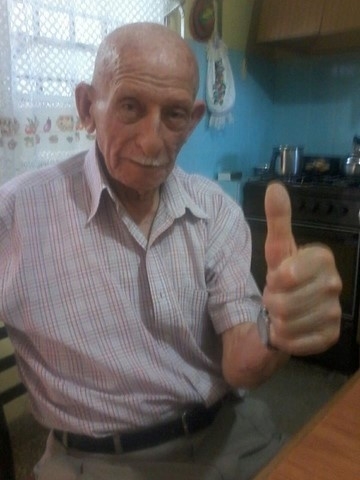
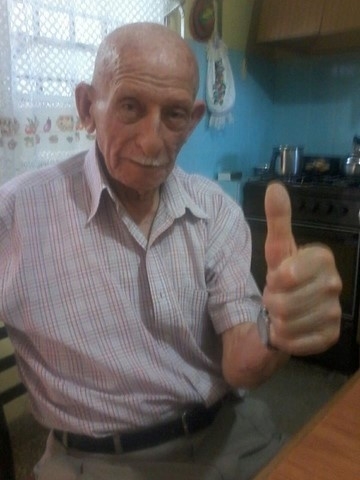
The first one
This is the transcript of an informal interview with Brother Antonio Videla at a gathering of former prisoners who had been imprisoned for conscientious objection in Embalse, Córdoba. The audio was transcribed, and some adjustments were made to arrange the account chronologically while preserving the spirit of the interview. The video recording is available.
What year were you called up for military service?
In 1948. I was baptized in December 1947, and two months later I was inducted. I was almost 21 at the time.
Do you remember how many Witnesses there were in the city of Córdoba back then? How many congregations?
I think there were 36 brothers and sisters, just one congregation. The first time I attended a meeting, there were 28 of us. The meeting place was on Alvear Street. If you know Córdoba, it was toward downtown, near the Córdoba Sport Club, where boxing matches were held. It was very close to there, in a brother’s house, a large house. We couldn’t have fit any more people in there.
Where were you assigned?
To the Air Force, at the paratrooper school in Córdoba. On the day I was being inducted, while we were already traveling, I woke up with a swollen throat. I told a corporal, “Look, my throat is swollen. I think I have mumps.”
They took me out of the line. A doctor came, examined me, and said, “Yes, take him out, take him out.” They took me to the Military Hospital, where I stayed for fifteen days. When I was discharged, they sent me back to the paratrooper school in Córdoba.
I spent two months there doing exercises, standing guard, and carrying out duties in different places. But I did not salute the flag. The flag had to be lowered in the afternoon and raised in the morning. I avoided doing it, but one day it was my turn. The corporal in charge of the barracks told me to raise the flag. I told him, “No, no, I can’t.”
There was a lieutenant there who said, “I’m ordering you to do it.”
I told him I couldn’t, and he asked me what was wrong. I explained that I couldn’t do it because of my religious conscience.
Then he said, “All right, you’re going to the guardhouse.”
They took me there, and I was held incommunicado until ten that night, from ten in the morning until ten at night. Someone came, though I don’t know what his rank was, took my statement, and asked me some questions. Then he lifted the restriction on communication.
I was very calm. Finally, he said, “But you’ve been in the service for two months. You already know the regulations, and you must obey them.”
I replied, “I respect the regulations too, as long as they don’t conflict with my service to God. So do whatever you feel you must.”
But they didn’t lay a hand on me or mistreat me. Everything was fine. They treated me with great respect.
Once, they asked me who had taught me. I gave them the name of an elder, Natalio Dessilani. They asked him to come and speak with them, and he gave them the booklet God and the State.
The day after Natalio’s visit, they told me, “One of your people came, the one who taught you, and he brought a booklet, God and the State. Very good.”
So they knew whom I had been meeting with. But afterward, they didn’t say anything else to me.
They told me I had to appoint a defense representative who was a member of the military. A second lieutenant was assigned. They put me on trial for insubordination, for failing to obey the orders I had been given. I waited four months before the trial took place.
They sentenced me to five years. My defense representative told me, “We’re going to appeal.” He did, and my sentence was reduced by five months.
I stayed there another six months before they transferred me to Buenos Aires. They took me to the First Air Brigade at El Palomar. I spent four months at that unit. They treated me well because some officers and noncommissioned officers who had known me while I was imprisoned in Córdoba had also been transferred to the brigade at El Palomar. As soon as they saw me, they came over and greeted me very warmly. So I was all right. Those four months went well.
Then they took me to the National Penitentiary in the city of Buenos Aires. I served the rest of my sentence there.
How did you feel when you entered the civilian prison?
I had never even been inside a police station. I didn’t know what it was like or how it worked. I knew there were offenders and criminals there, but I wasn’t worried because I didn’t know what prison life was like.
They checked me in and had me sign a paper. A guard said, “Come with me. We’re taking you to your cell.”
It was an individual cell. That was the good thing about the place: you had your own cell. They gave me cell number 64. It had a bed, a small table, a chair, and a shelf where I could put a few things.
The door closed automatically and couldn’t be opened from the inside. Unless someone opened it, you stayed in there. There was a bell you could ring to call the guard.I spent almost four years there.
Since you had been transferred from military custody, were you treated differently from the civilian prisoners?
There was a wing exclusively for military prisoners. It had 120 cells.
Were you allowed leaveTemporary permission to leave a military unit or place of detention.View in glossary?
No. Never, never. And I had no relatives in Buenos Aires, so there was no one who could visit me.
Did no one ever visit you?
A brother who heard about me came. He was from Córdoba, Antonio Torcigliani. He came to visit and told me, “If you want, I’ll come and visit you once a month.”
I passed that information on to the guards. They told me that since I had no family there, they would authorize his visits. So he came once a month.
Was he your only visitor?
My only visitor. And he brought me the magazines.
Were any other brothers imprisoned around that time?
Yes, Reynoso, from Córdoba. But he arrived after I had already been there for a year and a half. There was also a brother from La Plata, Paruchevsky. There were three of us Witnesses.
Were you allowed to meet together and study?
Yes. We had books to study, and there was a Bible in the library. We received The Watchtower and Awake! Once, an issue of The Watchtower contained information about religion, and the people inspecting incoming materials wouldn’t let it through.
Do you remember which book you studied?
Reconciliation.
Were your family members Witnesses too, or were you the only one?
No, I was the only one.
What did they say when all this happened?
They said I was crazy. They said all kinds of things.
Did you Witnesses have any work or activities within the prison wing?
I learned carpentry. One learned painting, and the other learned electrical work.
What was your daily routine like?
We worked from nine in the morning until noon. They paid us. I don’t remember how much, but they paid us something.
When I was released, I had no clothes. I wasn’t going to leaveTemporary permission to leave a military unit or place of detention.View in glossary wearing the striped prison uniform. They took my measurements and told me, “We’re going to buy you a suit, a shirt, an undershirt, underwear, a pair of shoes, socks, and a tie.”
They had everything ready for my release. I was released at midnight.
What did you do when you got out?
I didn’t leaveTemporary permission to leave a military unit or place of detention.View in glossary alone. A sergeant accompanied me to the Third Air Brigade in Reconquista, Santa Fe, where I rejoined the service. We traveled there by train.
Once they took me to Reconquista, I could go out every day. But I didn’t go out much because I had nowhere to go and no money either.
I spent eight months there after being reinstated, until I completed the required period of compulsory military service. Then they discharged me and gave me my military registration booklet.
What happened there?
Nothing. I didn’t do anything. I could go out from six in the evening until eight the following morning.
I looked for the Witnesses in Reconquista. On Saturdays, I would walk around to see whether I could find any brothers, but I didn’t find anyone.
There was a woman near the terminal who ran a boardinghouse. I went and asked her. She didn’t know anyone, but I asked whether there were people who brought The Watchtower.
She told me, “Yes, they come by sometimes. Sometimes. I’ve even read the magazines several times.”
But she didn’t know where they were from or where they went.
Two or three months passed, and a man I met told me, “Look, I read the magazine, and I think there’s a family at the far end of a street over there that studies the Bible with it.” So I walked over there. I arrived and clapped my hands outside a house to get someone’s attention. I wasn’t even sure which house it was, and I didn’t know the family’s name.
I said, “Look, I’m trying to find a family that receives or reads The Watchtower.” “Oh! Yes, they’re over there.”
I went over, and it was true. I asked, “Who visits you? Who brings you the magazine?”
They replied, “There’s a man who is German, but he lives 50 kilometers from here. He comes every fifteen days. If you come on such-and-such a Saturday, you’ll find him here.” So I went. I met him on Sunday.
Who was the brother?
Leon Kwidzinski, who came from Romang. We talked, and he got to know me. I told him, “Look, I want to study. I want to read the magazine. I want to make the most of every opportunity I can. I know you don’t know me.”
Did you explain that you had been imprisoned?
Yes, yes.
What did the brother say?
He was happy to have found me. He asked, “Do you have any clothes?” I told him I only had what I was wearing.
Then he said, “I’ll take your measurements and make you a suit.”
So he took my measurements and made me a double-breasted suit. And things began to develop. A small group formed in Reconquista, and I led that group.
There was a young man at the base who had become my friend. He was a new soldier from the town, and he asked me, “What are you going to do when you’re discharged, Videla?”
I told him, “I don’t know, but we’ll find something to do.”
What could I tell him? I couldn’t count on my family because they didn’t want me around.
He said, “Look, if you stay here, I’ll get you a job at Tapati, at the oil factory.”
I accepted. Once I was discharged, I stayed for a year to save some money.
I asked the woman who ran the boardinghouse whether she could rent me a small room for a year.
She replied, “I’ll give you a little room. I won’t charge you for it, only for the meals.”
So I stayed there, in that woman’s home, with her family. She didn’t charge me anything for the room. After I had been there about five or six months, she even started giving me meals without charging me.
I stayed there working for a year. Then I went back to Córdoba for a visit, to see how things were going and which brothers I could find, because there hadn’t been many back then. Five years had passed, and there had been quite a lot of growth.
It happened that Brother Knorr was visiting when I first returned to Córdoba. They were holding an assembly out in the countryside, because we were banned, at the home of the woman who is now my wife. It was a large country property.
We went there on Sunday with these brothers, and there were already a hundred of us. We spent the whole day there listening to talks and presentations.
Do you remember the year?
1952 hadn’t ended yet. The next day, Monday, I went back to work. I worked the remaining months to complete the year, and then I moved back to Córdoba.
Did your family ever share your faith?
No, not at all.
Did you ever see the men you had been with in the civilian prison again?
No. Never again.
When you were discharged, did they put any special notation in your documents?
I don’t remember.
What year were you able to return to a normal life of your own?
At the beginning of 1953. Almost six years.