The case of Juan Fontela... FONTELA, Juan, class yearBirth-year cohort used to organize military-service call-ups.View in glossary 1953
He was incorporated into the Amphibious Engineers Group 601, Santo Tomé, declared a conscience objector, and was detained, over time some francs were released, but then he was delivered dead to the family. According to the official report, he died of Chagas disease.
The family (not TJ) received the coffin sealed with welds, with the indication that it should be buried that way, they also opened the box and found that the skull was fractured and many blows on the body, evidence of mistreatment and torture. The case remained as it was.
Account of Oscar Schymalski; He was born in Misiones. He had come to Rosario and became a criminal who used weapons to rob houses. He was a boy who feared nothing, then he learned the truth and changed...
When it was time for military service, he preached recklessly to the military. He himself told us that he cited the text of Revelation which says that the birds will eat the meat of the military commanders in Armageddon. Of course, this did not win the sympathy of those who had him imprisoned.
By a neighbor who was serving with him in Santo Tomé (S.F.), I learned some details of his death. There was a Sergeant who resented him and had said that if he did not want to wear the uniform while alive, he would wear it dead.
According to my neighbor, they beat him, apparently unwillingly.
Then he regretted his conscience and they named a boat that Soldado Fontela used.
The body was sent to his family in Misiones. He was wearing the military uniform, the Argentine flag on the coffin, and a Guard of Honor accompanied him.
Account of Sergio Mantello I personally met Juan Fontela, that was in 1972, in fact we were friends. He was a few years older than me.
We were in the Barrio Acindar congregation, he started to gather, then became a publisher. He was from a colony near Oberá, Misiones.
So we would go out to preach together, and we also went fishing with the group of friends from that congregation, those from Las Delicias and Saladillo (the southern area of the city of Rosario). He was quite active in the preaching activity.
He was from a poor family, he did not know what Oscar Schymalski commented about his previous "activities", at that time he already worked as a mason's helper for the father of a friend's sister.
He was very impulsive (not filtering much what was between his brain and his tongue), cheerful and quite playful. He was also a very noble person, generous, and a good companion.
In fact, since he was older than the rest, he sometimes protected us when some wanted to get into the football games in "el potrero" that we used.
One day he was summoned for Military Service, he incorporated there in Rosario in the Communications Battalion 121 (we were several who accompanied him to the door), from there he was transferred to 601 of the Amphibious in Santo Tomé, Santa Fe. Months passed and one day they started giving him francs, and he came to visit us at home. He was always the same.
One day it started to be said that he had died.
And the bad news was confirmed when they contacted the parents and they confirmed that they had received the coffin sealed and welded, with a note that he had died of "Chagas disease" and that therefore they should not open the box. There was a guard of honor, and in fact they had put his name "Soldado Juan Fontela" on a boat or barge.
The father doubted that and opened the drawer and found that the body was beaten and the head sunken as a result of a blow.
But they did not proceed with anything else. And nothing more was ever known about the case.
Then more turbulent times came. And so his case remained, unresolved. Like so many others in that time and some of us, while in barracks, knew cases of soldiers who died from accidents and blows, medical neglect or abandonment, but it was hidden.
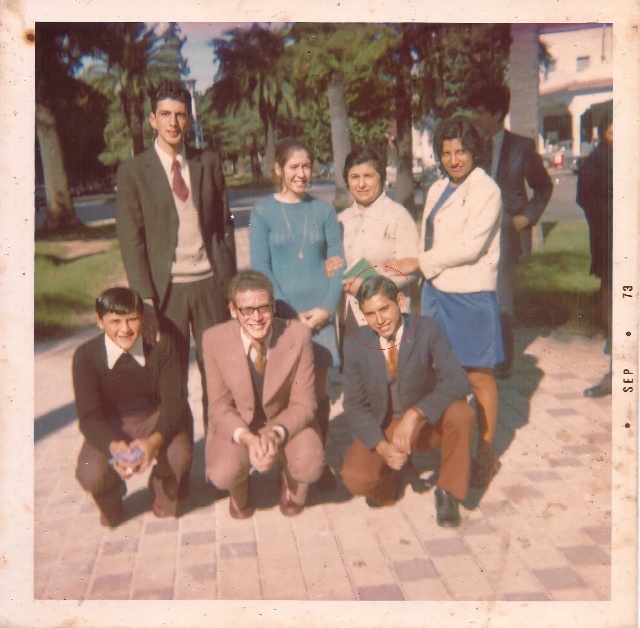
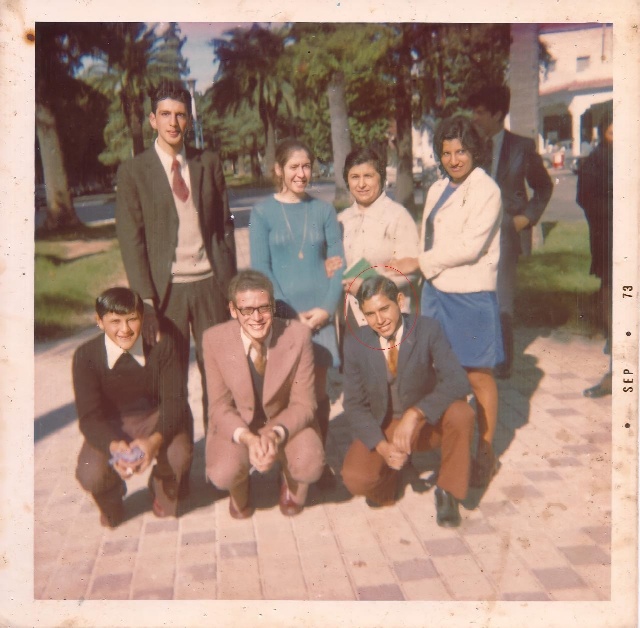
[image: Juan Fontela: Photograph of the day of his baptism on May 6, 1973]
Juan Fontela: Photograph of the day of his baptism on September 6, 1973. It is in the first row, bottom, the third to the right. The photograph was taken in front of the Cine Teatro Real (Bv. Oroño y Salta).